CBCT Imaging Guidelines and Radiation Safety: Evidence-Based Protocols for Dental Practice
Comprehensive evidence-based guide on CBCT imaging guidelines and radiation safety for dental professionals. Covers justification, dose optimisation, field-of-view selection, interpretation responsibilities, and clinical applications across specialties.

CBCT Imaging Guidelines and Radiation Safety: Evidence-Based Protocols for Dental Practice
Introduction
Cone beam computed tomography (CBCT) has expanded what clinicians can visualise in the dento‑maxillofacial region by providing three‑dimensional datasets (voxels) rather than two‑dimensional projections. In the United States, CBCT entered dentistry in the late 1990s and has since become widely used across oral surgery, orthodontics, implant dentistry and endodontics.
The clinical value of CBCT comes with an obligation: use it only when it is justified and optimise every scan. Compared with conventional dental radiography, CBCT typically delivers higher patient radiation doses (though usually lower than many medical CT examinations), and dose varies greatly by device and protocol. Evidence-based selection criteria, accurate positioning, strict field-of-view (FOV) limitation and robust interpretation workflows are essential.
This guide synthesises current, evidence-based recommendations for CBCT justification, dose optimisation and safe implementation in daily dental practice.
CBCT fundamentals and dose in context
How CBCT works (clinically relevant overview)
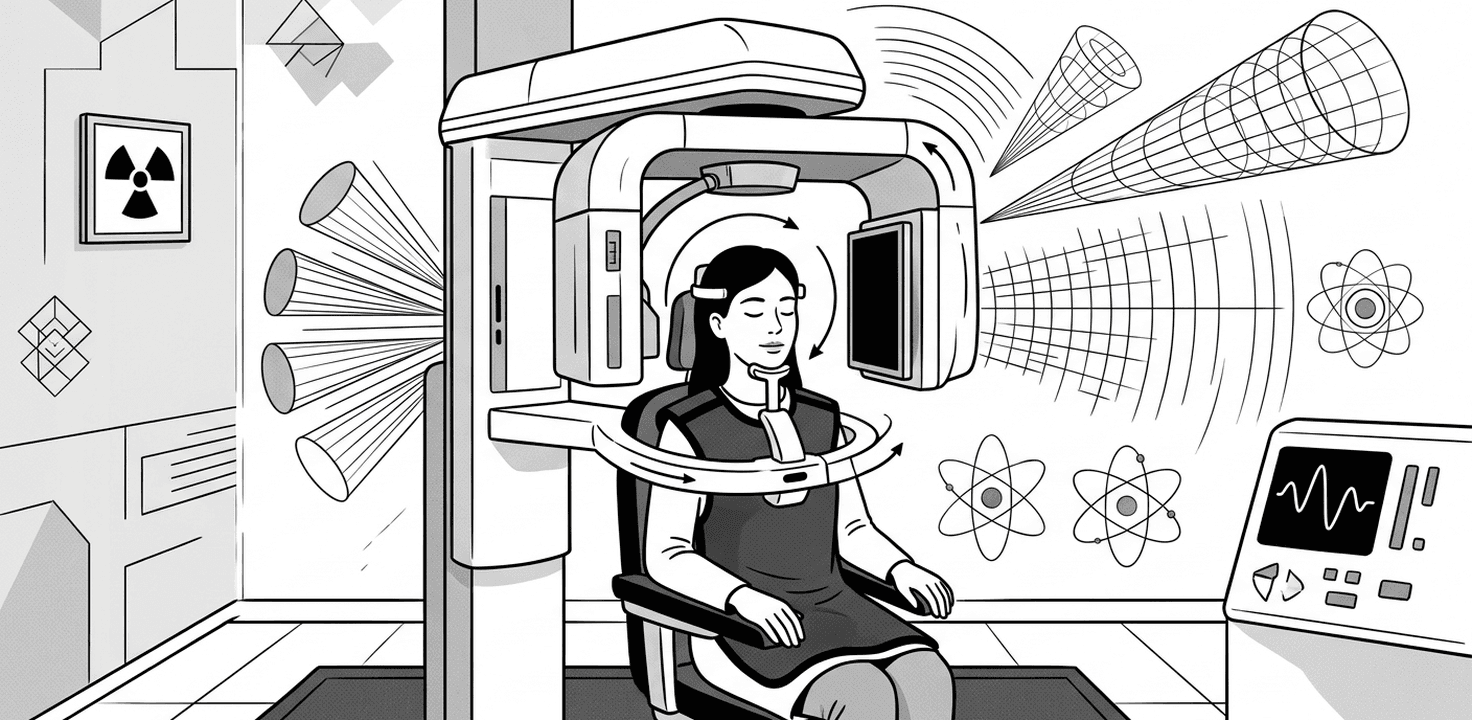
Dental CBCT systems rotate around the patient, capturing data using a cone-shaped X‑ray beam. The reconstructed 3D dataset allows multiplanar and cross-sectional viewing for the teeth, jaws and surrounding structures. (In many clinical systems, the rotation yields hundreds of projections that are reconstructed into voxels.)
CBCT image characteristics depend on:
- Voxel size (smaller voxels → higher spatial resolution but often higher dose and more noise)
- FOV (larger volumes irradiate more tissues and tend to increase effective dose)
- Exposure parameters (kVp, mA/mAs, scan time, pulsed vs continuous exposure)
- Patient factors (size, motion, presence of metal restorations/implants)
Effective dose ranges (what the evidence supports)
Because device design and protocols vary, there is no single “CBCT dose”. The most useful approach is to describe ranges and explain why they vary.
Comparative effective dose ranges (selected examinations)
| Examination | Effective dose (mSv) | Effective dose (μSv) |
|---|---|---|
| Intra-oral periapical/bitewing | 0.0003–0.022 | 0.3–22 |
| Panoramic radiograph | 0.0027–0.038 | 2.7–38 |
| Lateral cephalometric radiograph | 0.0022–0.0056 | 2.2–5.6 |
| Dento‑alveolar (small-volume) CBCT | 0.01–0.67 | 10–670 |
| Craniofacial (large-volume) CBCT | 0.03–1.1 | 30–1100 |
| CT mandible and maxilla (medical CT) | 0.25–1.4 | 250–1400 |
How to interpret this table
- CBCT effective dose overlaps with other modalities depending on protocol.
- Small-volume CBCT protocols can be in the same order of magnitude as multiple intra-oral images, but can also be substantially higher depending on settings and anatomy covered.
- Large-volume CBCT may overlap with lower-dose maxillofacial CT protocols, but many medical CT protocols (especially trauma protocols) may be higher than the dental-focused ranges above.
What drives CBCT dose most
Field of view and protocol choice are the dominant levers. A large meta-analysis of dental CBCT effective doses reported:
- Large FOV (>15 cm height): standard protocol 46–916 μSv (adult)
- Medium FOV: standard protocol 47–560 μSv (adult)
- Small FOV: standard protocol 5–140 μSv (maxilla-only) and 18–488 μSv (including the mandible) Across any protocols (not just standard), reported adult doses extended up to ~1073 μSv, underscoring the importance of protocol selection.
Paediatric doses tend to be higher than adult doses for comparable imaging tasks, and children are also more radiosensitive and have longer time horizons for potential stochastic effects.
Evidence-based referral criteria
The core principle: justification
Professional and regulatory guidance is consistent on the foundational point:
- Start with a thorough history and clinical examination.
- Define the clinical question.
- Use the lowest-dose imaging option that can answer that question.
- Use CBCT only when it is likely to change diagnosis, treatment planning, or management.
- Document the justification reasoning in the patient record.
International evidence-based guidance explicitly states that CBCT should not be used as “routine” or “screening” imaging. The FDA similarly advises that CBCT should be performed only when necessary to provide information that cannot be provided using other imaging modalities, and encourages reviewing imaging history to avoid duplication.
Interpretation responsibility (often overlooked)
If you order or acquire a CBCT scan, you (or an appropriately trained designee) must ensure the entire volume is interpreted, not just the region of primary interest. Incidental findings can be clinically relevant, and CBCT interpretation extends beyond tooth-level diagnosis.
If interpretation is outside your scope or training, establish a referral relationship with an oral and maxillofacial radiologist and formalise a reporting workflow.
Specialty-specific guidance (practical, defensible indications)
Implant dentistry
- Initial evaluation: panoramic radiography is typically the imaging modality of choice, supplemented by intra-oral periapicals as needed.
- Cross-sectional imaging (often CBCT) is recommended for site-specific preoperative implant assessment when bucco‑lingual measurements and proximity to vital structures must be evaluated.
- CBCT is not recommended as the initial diagnostic imaging examination for implant patients.
- CBCT should not be used for periodic review of clinically asymptomatic implants.
Endodontics Endodontic guidance supports intra-oral radiography as first-line imaging, with limited-FOV CBCT considered for specific problems, such as:
- contradictory or non-specific signs/symptoms with inconclusive 2D imaging
- suspected complex canal morphology (where 2D imaging is insufficient)
- assessment of non-healing cases, retreatment planning, and surgical planning
- evaluation where 2D imaging is inconclusive for suspected vertical root fracture
- trauma assessment and resorption characterisation
Important nuance: CBCT is helpful in many endodontic scenarios, but it is not infallible—metal artefacts and root filling materials can impair diagnostic performance (especially for fracture line visualisation). Use the smallest FOV and task-appropriate settings.
Orthodontics CBCT should not be routine for orthodontic diagnosis. It may be justified in selected scenarios where 2D imaging is inadequate, such as:
- localisation of impacted teeth when conventional views cannot provide the information required
- assessment of resorption or complex dental anomalies
- cleft palate/craniofacial anomalies when clinically indicated
- orthognathic planning when a large-volume dataset is necessary and justified
Taking a large-volume CBCT simply to generate a synthesised cephalogram is generally not indicated when a standard cephalometric radiograph would suffice.
Oral surgery A well-supported example indication is mandibular third molar assessment only when conventional radiographs suggest a close relationship between third molar roots and the mandibular canal and a decision for surgical removal has been made. CBCT should not be used routinely for all third molar pre-surgical assessments.
Periodontics Routine CBCT for periodontal disease assessment/monitoring is not supported. Consider small-volume CBCT only for complex cases where 2D imaging cannot answer the clinical question (e.g., selected severe defects or anatomical complexity), and where results will change management.
Radiation safety and dose optimisation in practice
Patient shielding: what has changed (and what to do now)
Current ADA expert-panel guidance (JADA 2024):
- Thyroid collars are no longer recommended for any dental imaging modality (intra-oral, panoramic, cephalometric, CBCT) as routine practice.
- Abdominal/gonadal lead shielding is also not recommended as routine practice.
- Rationale includes risk of artefacts/obscured anatomy and retakes, and minimal benefit for internal scatter. The guidance also notes that regulations should be updated where they still imply routine shielding.
Practical takeaway
- Focus on measures that consistently reduce dose without increasing retakes:
- correct patient selection
- limiting FOV to the region of interest
- correct positioning and immobilisation to prevent motion
- protocol optimisation (especially for children)
- staff training and QA/QC
Important caveat Always comply with applicable local regulations. Where shielding is still legally required, follow the regulation while applying all optimisation steps to avoid repeats.
High-impact optimisation steps
Choose the smallest FOV consistent with the clinical task
- Single tooth / localised endodontic problem: limited/small FOV
- Single implant site: small FOV if anatomy allows
- Quadrant: medium FOV only if required
- Full arch or craniofacial: large FOV only with clear justification
Optimise voxel size and “resolution” Use the lowest resolution that still answers the clinical question. High-definition protocols can materially increase dose and are often unnecessary for many diagnostic tasks.
Use paediatric protocols Children should not be scanned with adult settings by default. Use child-size exposure protocols, smallest feasible FOV, and task-appropriate resolution.
Prevent motion and retakes
- stable head support and clear patient instructions
- check positioning carefully before scanning
- remove metallic objects where possible
- consider shorter scan times when available and adequate
Reduce dose by good collimation in 2D imaging For intra-oral imaging, rectangular collimation can reduce dose substantially compared with round collimation, and poor collimation can increase dose several-fold. Good 2D technique reduces the need to “escalate” to 3D unnecessarily.
Pregnancy: patient safety message clinicians can stand behind
- Dental radiography (including CBCT) can be performed in pregnancy when clinically justified.
- Typical foetal dose from dental radiography (including CBCT) is extremely low (reported in the μSv range).
- If imaging is essential, it should be performed with optimisation (e.g., smallest FOV, appropriate settings, avoidance of retakes).
- Counselling should focus on the clinical benefit and the very small radiation risk at dental doses.
Implementation, QA/QC, and compliance
A safe CBCT workflow (minimum defensible elements)
Before the scan
- clinical examination + clear clinical question
- review prior imaging and avoid duplication
- document indication and why 2D is insufficient
- select protocol/FOV/voxel size appropriate to task and patient size
- explain benefits/risks and obtain informed consent
During the scan
- correct positioning; immobilise as needed
- ensure FOV truly matches the region of interest
- use manufacturer-recommended exposure protocols and dose-reduction options
After the scan
- interpret the entire volume (or refer for radiology reporting)
- document findings and incidental findings, and communicate clinically relevant results
- retain images and reports according to local record-keeping rules
Quality assurance and quality control (what to include)
QA/QC requirements vary by jurisdiction and manufacturer, but evidence-based guidance supports:
- commissioning and acceptance testing at installation
- periodic performance checks (often involving a QA phantom where supplied)
- clinical image quality review as part of QA
- documentation of maintenance and corrective actions
- staff training and continuing professional development in CBCT operation and interpretation
Rather than fixed “one-size-fits-all” intervals, align your QC schedule with:
- manufacturer recommendations
- local regulations/inspection requirements
- the practice’s scan volume and clinical risk profile
Occupational radiation safety (what to train and enforce)
Key elements of staff protection include:
- keeping operators out of the primary beam and using barriers where provided
- maintaining distance where barriers are not available (principles of time, distance, shielding)
- using personal monitoring when required by regulation or when exposures could exceed monitoring thresholds
- documented training and written radiation safety procedures
References
-
Benavides E, et al. Optimizing radiation safety in dentistry: Clinical recommendations and regulatory considerations. J Am Dent Assoc. 2024;155(4):281–297.
-
U.S. Food and Drug Administration (FDA). Dental Cone-beam Computed Tomography. Updated guidance page and safety information for patients and dental professionals.
-
American Dental Association (ADA) & U.S. FDA. Dental Radiographic Examinations: Recommendations for Patient Selection and Limiting Radiation Exposure. Revised 2012.
-
Horner K, et al. Cone Beam CT for Dental and Maxillofacial Radiology: Evidence-Based Guidelines (Radiation Protection No. 172). European Commission / SEDENTEXCT; 2012.
-
Ludlow JB, et al. Effective dose of dental CBCT—a meta-analysis of published data and additional data for nine CBCT units. Dentomaxillofac Radiol. 2014/2015.
-
Tyndall DA, et al. AAOMR position statement on selection criteria for radiology in dental implantology (with emphasis on CBCT). Oral Surg Oral Med Oral Pathol Oral Radiol. 2012;113:817–826.
-
American Association of Endodontists (AAE) & American Academy of Oral and Maxillofacial Radiology (AAOMR). Use of Cone Beam Computed Tomography in Endodontics: 2015 Update (Joint Position Statement). 2015.
-
American Academy of Oral and Maxillofacial Radiology (AAOMR). Clinical recommendations regarding use of CBCT in orthodontics (Position Statement). 2013.
-
AAOMR. Patient shielding during dentomaxillofacial radiography: Recommendations. JADA. 2023.
-
British Orthodontic Society. Orthodontic Radiographs: Guidelines for the Use of Radiographs in Clinical Orthodontics. 2016.
-
International Atomic Energy Agency (IAEA). Radiation protection of pregnant women in dental radiology. (Radiation Protection of Patients guidance).