
Clear Aligner Therapy: Evidence-Based Analysis of Clinical Efficacy and Biomechanical Limitations
Clear aligner therapy has transformed orthodontic treatment since its introduction in the late 1990s. What began as a niche aesthetic alternative to traditional braces has evolved into a mainstream treatment modality used by millions worldwide. But beneath the marketing promises and patient enthusiasm lies a complex biomechanical reality that every dental professional must understand.
This comprehensive analysis examines the clinical evidence supporting clear aligner therapy, its inherent biomechanical limitations, and evidence-based guidelines for case selection. Understanding these factors is essential for achieving predictable outcomes and setting realistic patient expectations.
The Rise of Clear Aligner Therapy
Clear aligners have gained remarkable popularity due to their aesthetic advantages, patient comfort, and improved oral hygiene compared to fixed appliances. The technology has advanced significantly with digital treatment planning, artificial intelligence integration, and improved thermoplastic materials.
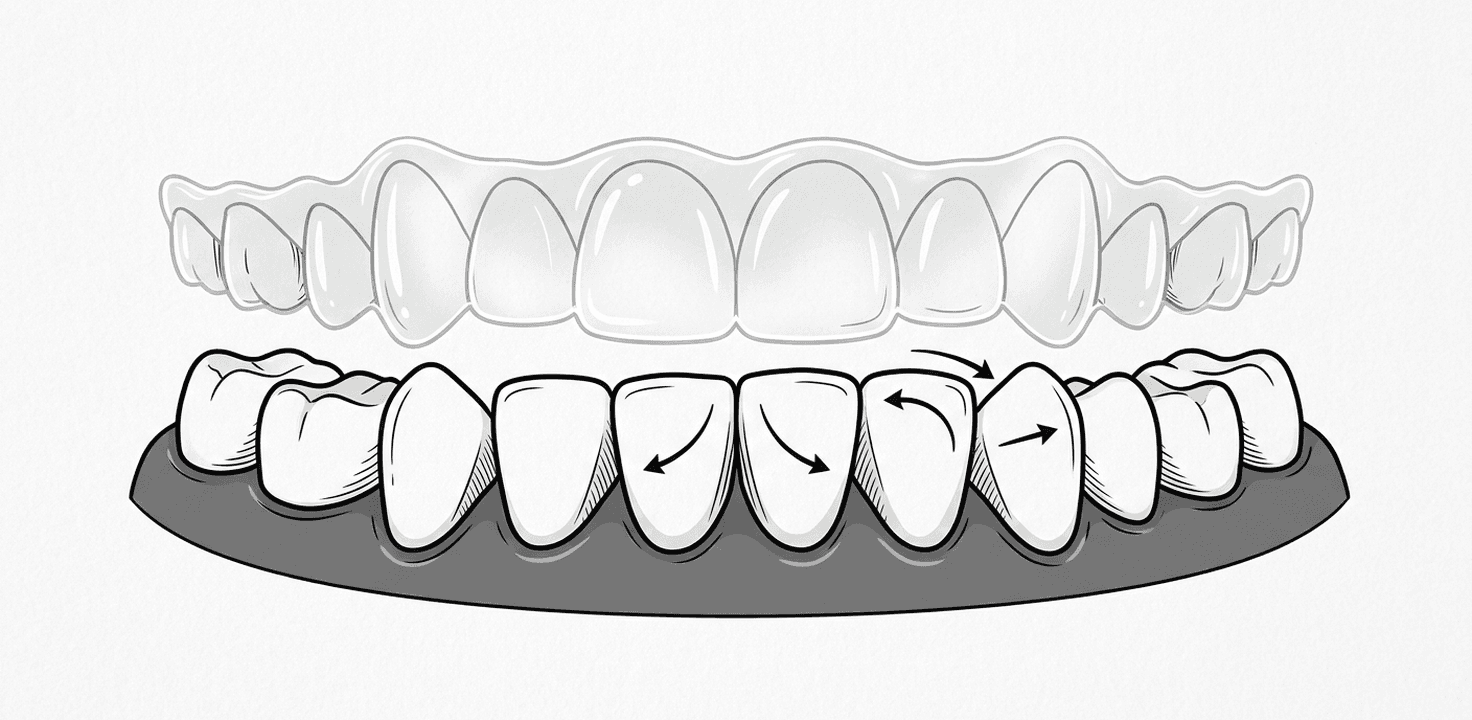
However, the fundamental biomechanics of clear aligner therapy remain distinct from traditional fixed appliances. While fixed braces use continuous forces from archwires, aligners rely on shape-recoverable polymer membranes to generate orthodontic forces. This difference in force delivery mechanisms creates unique advantages and limitations that clinicians must consider.
Clinical Effectiveness: What the Evidence Shows
Treatment Outcomes and Predictability
Multiple systematic reviews and meta-analyses have evaluated the clinical efficacy of clear aligner therapy. Research indicates that clear aligners demonstrate adequate effectiveness for mild to moderate malocclusions, particularly in non-extraction protocols for nongrowing patients.
A landmark study by Djeu et al. compared treatment outcomes between clear aligner therapy and fixed appliances using the American Board of Orthodontists grading system. The aligner group scored 13 points lower than the fixed appliance group, resulting in a 27% reduced passing rate. The greatest discrepancies were observed in posterior torque, occlusal contacts, overjet, and sagittal molar relationships.
Kravitz et al. reported that the overall accuracy of tooth movement with clear aligner therapy averages approximately 41%. This finding emphasizes the importance of careful case selection and awareness of treatment limitations. The literature consistently reports roughly a 50% discrepancy between predicted and clinical outcomes, often necessitating multiple refinement stages.
Specific Movement Accuracy
Deep Bite Correction
Research on deep bite correction reveals moderate accuracy. Dianiskova et al. reported mean curve of Spee leveling accuracy of 62% and mean overbite reduction accuracy of 61%. While these results demonstrate clinical utility, they indicate that aligners achieve only moderate precision in programmed movements for deep bite correction.
Torque Expression
Rajan et al. investigated torque expression in maxillary central incisors and found a clinically significant shortfall when greater than 10 degrees of lingual root torque was planned. The achieved torque was less than half of what was prescribed, regardless of power ridge inclusion or aligner change protocol. This finding has critical implications for treatment planning, suggesting that overcorrection may be necessary for torque-dependent movements.
Molar Distalization
Interestingly, molar distalization demonstrates the highest predictability among clear aligner movements. A systematic review found that molar distalization achieves approximately 87% effectiveness, outperforming movements such as incisor torque and premolar derotation. This high predictability makes distalization cases particularly suitable for aligner therapy.
Biomechanical Limitations
The Challenge of Torque Control
Torque control represents one of the most significant biomechanical limitations of clear aligner therapy. In orthodontics, torque refers to the rotational force necessary for root movement, achieved through force couples in fixed appliances.
Traditional fixed appliances generate high-force loads concentrated around bracket slots, enabling effective torque development. Clear aligners, however, struggle to generate comparable force couples due to their material properties and removable nature.
Research using finite element analysis reveals that clear aligners primarily deliver one-point force application, resulting in uncontrolled tipping rather than true root movement. When the center of rotation is located near the incisal edge, the apex moves in the opposite direction, producing tipping instead of torque.
A CBCT study examining torque planning found that for movements exceeding 10 degrees, torque loss of approximately 50% may occur. The success rate for torque planning of more than 5 degrees was approximately 47%, indicating substantial unpredictability.
Anchorage Considerations
Anchorage control presents another significant challenge. Fixed appliances benefit from rigid connections between teeth, allowing predictable anchorage management. Clear aligners lack these rigid connections, leading to potential anchorage loss and unwanted tooth movement.
Studies demonstrate that both direct strong anchorage and moderate anchorage approaches with clear aligners result in anchorage loss and posterior mesial tipping. However, indirect strong anchorage using metallic ligation can provide anchorage protection and minimize unwanted movements.
Force Degradation and Intermittent Loading
Clear aligners exert their highest orthodontic force immediately upon insertion, with force decreasing by 20-30% within the first two days. This force degradation continues throughout the wear period, resulting in intermittent rather than continuous force application.
Unlike fixed appliances, where nickel-titanium wires maintain consistent energy transfer, aligners experience rapid force decline due to material fatigue. This characteristic affects treatment efficiency and predictability, particularly for movements requiring sustained force levels.
Patient-Reported Outcomes
Comfort and Satisfaction
Patient satisfaction studies consistently favor clear aligners in specific domains. Almogbel et al. reported significantly higher satisfaction scores for aesthetics (8.7/10 vs. 5.4/10) and comfort (8.2/10 vs. 4.9/10) compared to traditional braces. Speech interference was also lower with clear aligners.
However, interestingly, no significant differences were observed in overall treatment effectiveness satisfaction between the two modalities. Both groups rated overall satisfaction similarly, indicating that while aligners offer aesthetic and comfort advantages, patients perceive equivalent treatment effectiveness.
Pain Experience
Cardoso et al. found that patients treated with clear aligners reported lower pain levels during the first few days of treatment compared to those with fixed appliances. After the initial period, no significant differences were noted between modalities. White et al. confirmed that discomfort with fixed appliances peaks between the first and third day following adjustments, especially during eating.
Compliance and Oral Hygiene
Clear aligners require strict compliance, with the typical protocol mandating 22 hours of daily wear. While this demands patient discipline, compliance rates remain high, with studies reporting 87-92% adherence rates.
The removable nature of aligners facilitates superior oral hygiene. Systematic reviews demonstrate lower plaque index scores, improved gingival health, and shallower probing depths with clear aligners compared to fixed appliances. White spot lesion incidence is dramatically reduced, with aligner patients showing only 1.2-2.85% WSL development compared to 26-46% with fixed appliances.
Root Resorption and Periodontal Health
Apical Root Resorption
Research indicates a lower prevalence and reduced severity of apical root resorption with clear aligners compared to conventional brackets. A systematic review and meta-analysis confirmed that clear aligners are associated with lower resorption incidence when controlling for variables such as age, malocclusion classification, and treatment plan.
The reduced risk is attributed to lighter, more controlled, and intermittent forces that allow periods of cemental repair. Additionally, aligners exert less torque and intrusive force, factors implicated in root resorption pathogenesis.
Periodontal Outcomes
Clear aligners demonstrate favorable periodontal outcomes due to improved oral hygiene and intermittent force application. Studies show reduced gingival recession and bleeding on probing compared to fixed appliances. These benefits are particularly relevant for adult patients with pre-existing periodontal conditions.
Clinical Applications and Case Selection
Ideal Cases for Clear Aligner Therapy
Based on current evidence, clear aligners are most appropriate for:
- Mild to moderate crowding with non-extraction protocols
- Cases requiring molar distalization
- Patients with normal pretreatment overbite seeking maintenance
- Open bite cases requiring bite opening
- Adult patients prioritizing aesthetics and comfort
- Patients with elevated caries risk or periodontal concerns
Cases Requiring Caution
Clinicians should exercise caution or consider alternative approaches for:
- Deep bite correction requiring significant overbite reduction
- Cases requiring torque changes exceeding 10 degrees
- Complex three-dimensional movements
- Severe rotations, particularly of premolars and canines
- Extraction cases requiring significant anchorage control
- Growing patients with complex skeletal discrepancies
The Role of Attachments and Auxiliaries
Attachments have become essential for improving clear aligner biomechanics. Research demonstrates that strategic attachment placement can enhance movement predictability for rotation, extrusion, and torque.
Horizontal rectangular attachments show superior performance for torque movements, while vertical attachments are more effective for rotation. Optimized attachments offer biomechanical advantages in some movements, though clinical studies suggest their superiority over conventional attachments is not always statistically significant.
Power ridges, divots, and temporary anchorage devices can further augment clear aligner capabilities. TADs combined with aligners demonstrate enhanced treatment precision for complex movements such as intrusion and distalization.
Treatment Planning Strategies
Overcorrection Protocols
Given the documented discrepancy between predicted and achieved movements, overcorrection should be considered for:
- Torque movements, particularly exceeding 10 degrees
- Deep bite correction
- Curve of Spee leveling
- Rotations greater than 1.2 degrees per aligner stage
Refinement Expectations
Orthodontists report that 70-80% of clear aligner patients require mid-course corrections or refinements. Treatment planning should anticipate these additional stages and communicate expectations accordingly to patients.
Material Considerations
Multi-layer aligners with varying soft and hard layer compositions reduce impact on non-target teeth and root absorption while improving displacement accuracy. Thicker membranes (0.75mm) demonstrate improved torque expression compared to 0.5mm alternatives, though with increased periodontal stress.
Conclusion
Clear aligner therapy represents a valuable tool in modern orthodontics, offering significant advantages in aesthetics, comfort, and oral health. However, the evidence clearly demonstrates biomechanical limitations that practitioners must acknowledge and accommodate.
The 41-50% accuracy rate for tooth movement, challenges with torque expression, and anchorage limitations require careful case selection and treatment planning. Clear aligners excel in specific applications—particularly molar distalization, mild to moderate non-extraction cases, and situations where periodontal health is paramount.
For optimal outcomes, clinicians should:
- Select cases appropriate for aligner biomechanics
- Plan for overcorrection in torque-dependent movements
- Anticipate refinement stages in treatment planning
- Utilize attachments and auxiliaries strategically
- Set realistic patient expectations based on evidence
- Maintain proficiency in fixed appliances for complex cases
As materials science and digital planning continue to evolve, clear aligner capabilities will likely expand. However, the fundamental biomechanical principles governing orthodontic tooth movement remain constant. Success with clear aligner therapy requires not only technological proficiency but also a deep understanding of these biomechanical realities and their clinical implications.
References
-
Djeu G, Shelton C, Maganzini A. Outcome assessment of Invisalign and traditional orthodontic treatment compared with the American Board of Orthodontics objective grading system. Am J Orthod Dentofacial Orthop. 2005;128(3):292-298.
-
Kravitz ND, Kusnoto B, BeGole E, Obrez A, Agran B. How well does Invisalign work? A prospective clinical study evaluating the efficacy of tooth movement with Invisalign. Am J Orthod Dentofacial Orthop. 2009;135(1):27-35.
-
Rajan P, Kaur H, Bhushan M, Kaur S. Torque expression in clear aligner therapy: A systematic review. J Clin Orthod. 2022;56(4):220-228.
-
Dianiskova S, Yilidrim E, Kiliçoglu H. Clear aligner therapy in deep bite cases: Accuracy and predictability. Angle Orthod. 2022;92(4):462-469.
-
Almogbel A, Albarakati SF, Almarshad MA, Almalki MS. Patient satisfaction with clear aligners vs. traditional braces: A comparative study. J Contemp Dent Pract. 2025;26(2):78-83.
-
Cardoso PC, Espinosa DG, Mecenas P, Flores-Mir C, Normando D. Pain level between clear aligners and fixed appliances: A systematic review. Prog Orthod. 2020;21(1):3.
-
Brezniak N, Wasserstein A, Protter N. Clear aligner biomechanical limitations: Anchorage and couple (torque) development. Angle Orthod. 2023;93(5):615-616.
-
Li Y, Deng H, Mei L, Zhang X. A systematic review of biomechanics of clear aligners by finite element analysis. BMC Oral Health. 2025;25(1):112.
-
Almogbel A, Aljutaily H, Almalki MS. Clear aligner attachments: A comprehensive review. J Orthod Sci. 2025;14:12485647.
-
Borda AF, Garfinkle JS, Covell DA, Wang M, Doyle L, Sedky NA. Objective evaluation of the clear aligner therapy protocol and appliance. Angle Orthod. 2020;90(5):694-701.