Digital Dentistry Workflow Optimization: Evidence-Based Implementation Strategies for Modern Dental Practices
Comprehensive evidence-based guide on digital dentistry workflow optimization. Covers intraoral scanning, CAD/CAM systems, clinical efficiency gains, patient outcomes, and implementation strategies for modern dental practices.

Digital Dentistry Workflow Optimization: Evidence-Based Implementation Strategies
Introduction: The Digital Transformation of Dentistry
Digital dentistry has evolved from an emerging technology to a cornerstone of modern clinical practice. What began in the 1980s with early CAD/CAM systems has matured into a comprehensive ecosystem of intraoral scanners, 3D printing, computer-aided design, and automated manufacturing technologies that fundamentally reshape how dental care is delivered.
A 2024 systematic review by Mahato et al. analyzing 22 clinical studies found that digital workflows significantly reduce working time, eliminate tray selection, minimize material consumption, and enhance both patient comfort and acceptance. Patient-reported outcome measures consistently favor digital approaches, with satisfaction scores higher than conventional workflows across multiple parameters.
This guide synthesizes current evidence to provide actionable strategies for implementing and optimizing digital workflows in your practice—from single-tooth restorations to complex full-mouth rehabilitations.
Understanding the Digital Workflow Components
Intraoral Scanners: The Foundation
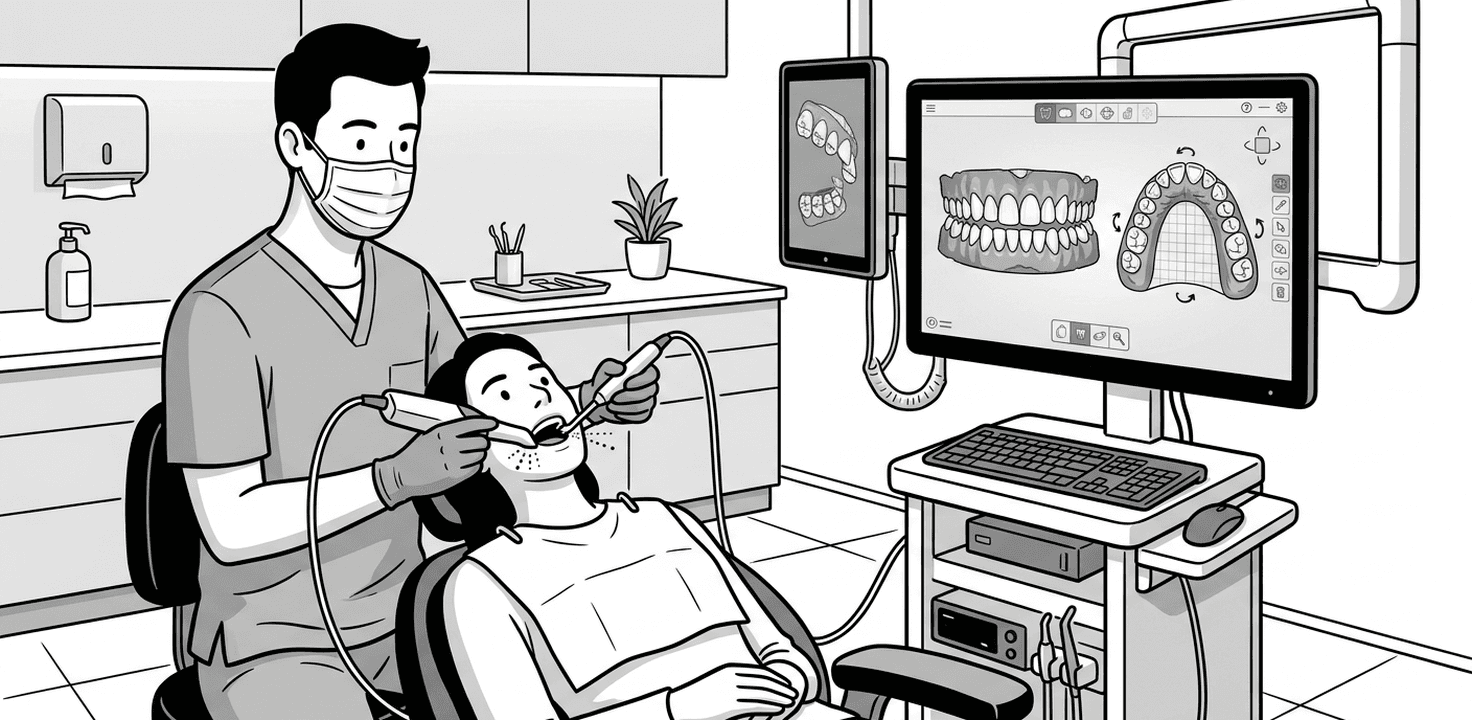
Modern intraoral scanners (IOS) represent the entry point into digital dentistry. These devices capture optical impressions using various technologies:
| Technology | Mechanism | Key Advantages |
|---|---|---|
| Confocal microscopy | Optical sectioning at different focal planes | Excellent for non-reflective, mobile tissues (edentulous arches) |
| Structured light | Projected light patterns analyzed by cameras | Fast capture, good accuracy |
| Active wavefront sampling | Measures light reflection patterns | High speed, continuous scanning |
Recent advances in IOS technology include:
- Continuous image capture with seamless stitching algorithms
- Full-color scanning for enhanced soft tissue representation
- Direct cloud-based data sharing with laboratories
- AI-enhanced scan quality assessment in real-time
- Integration with treatment planning software for orthodontics, implantology, and smile design
A 2024 review in PubMed Central highlights that IOSs now extend beyond CAD/CAM to serve as platforms for diagnostics, patient communication, and comprehensive treatment planning. Their ability to create accurate "digital twins"—3D models that provide precise anatomical details—has transformed orthodontic, surgical, and prosthodontic workflows.
CAD/CAM Systems: Design and Manufacturing
Computer-aided design and manufacturing systems complete the digital workflow:
Software Capabilities:
- Virtual articulation eliminating mechanical facebow transfers
- AI-assisted restoration design with automated anatomical suggestions
- Real-time margin detection and adjustment
- Occlusal contact analysis and optimization
- Smile design integration with facial scans
Manufacturing Options:
- Chairside milling: Subtractive manufacturing from ceramic or hybrid blocks (60-120 minutes for single crowns)
- 3D printing: Additive manufacturing for surgical guides, try-ins, denture bases, and provisional restorations
- Centralized milling centers: Laboratory-based fabrication for complex cases
- Hybrid workflows: Combining in-house scanning with outsourced manufacturing
Imaging Integration: The Complete Picture
Contemporary digital workflows integrate multiple imaging modalities:
- CBCT (Cone-Beam CT): Provides 3D bone assessment for implant planning
- Intraoral scans: Captures precise soft tissue and tooth morphology
- Facial scans: Enables digital smile design and aesthetic planning
- Digital photography: Documents color, texture, and patient expectations
Superimposition of these datasets creates comprehensive virtual patients, enabling precise treatment planning and predictable outcomes. As noted in Dentomaxillofacial Radiology, this imaging chain forms the basis of all digital workflows, and understanding error accumulation at each step is critical for clinical efficacy.
Evidence-Based Clinical Applications
Single-Tooth Restorations: Crowns, Inlays, and Onlays
Time Efficiency Evidence: Multiple randomized controlled trials demonstrate significant time savings with digital workflows:
- Pan et al. (2019): Digital workflow required significantly less laboratory time; model-free digital workflow reduced processing time further
- Zhang et al. (2019): Complete digital workflow showed significantly shorter clinical and laboratory times for lithium disilicate crowns
- Ren et al. (2021): Complete digital workflows for implant crowns demonstrated significantly shorter chairside and laboratory times
Precision Outcomes:
- Marginal fit is comparable between digital and conventional workflows
- Some studies show superior occlusal precision with digital approaches
- Crown adjustments at delivery are reduced with experienced digital operators
Patient Satisfaction:
- 15 of 16 patients preferred digital impressions over conventional in one RCT
- Patient comfort scores consistently favor intraoral scanning
- Visualization of treatment on-screen increases transparency and trust
Best Practice Protocol:
- Capture full-arch scans (not just the preparation) for occlusal context
- Ensure adequate margin capture with a 360-degree scan path
- Verify occlusal clearance using scan analysis tools
- Use high-translucency blocks for aesthetic anterior restorations
- Perform dry try-in before cementation to verify marginal integrity
Complete Dentures: Digital Revolution in Edentulous Care
Digital complete denture workflows represent one of the most significant advances in prosthodontics. A 2024 meta-analysis by Avelino et al. comparing 346 patients across 16 trials found that CAD/CAM dentures demonstrated denture base adaptation, retention, and clinician-rated quality scores comparable with or superior to conventional dentures.
Key Advantages:
- Reduced appointments (typically 2 visits vs. 5+ conventional)
- Pre-polymerized PMMA with superior mechanical properties
- Digital archiving enables rapid remakes without new impressions
- Consistent quality with reduced operator dependency
Optimized Digital Denture Protocol:
Research published in 2025 demonstrates that fully integrated digital protocols yield superior outcomes:
- Primary digital impression: Capture edentulous arch using confocal scanning
- 3D-printed custom tray: Design and print tray for border-molded functional impression
- Border-molded functional impression: Captures optimal mucosal extension (achieves 14-16 N retention vs. ~6 N for intraoral scans alone)
- Virtual articulation: Rescan tray-rim assembly to establish vertical dimension without facebow
- Digital try-in: 3D-printed try-in allows patient evaluation before definitive fabrication
- Definitive fabrication: Subtractive milling from high-performance PMMA discs
Clinical Outcomes: A case report with 6-month follow-up demonstrated:
- No post-delivery adjustments required
- High patient satisfaction with esthetics, retention, phonetics, and mastication
- Stable prosthesis adaptation without mucosal irritation
- Bond strength exceeding ISO 22112:2017 standards for tooth retention
Implant-Supported Restorations
Digital workflows excel in implant dentistry:
Surgical Phase:
- CBCT-merged scans enable precise virtual implant planning
- Surgical guides fabricated via 3D printing improve accuracy
- Dynamic navigation systems provide real-time guidance
Restorative Phase:
- Digital impressions capture emergence profile precisely
- Custom abutments designed for optimal soft tissue contour
- Screw-retained crowns fabricated with excellent passivity
Evidence Summary: A systematic review found that digital workflows for implant crowns showed:
- Comparable or better precision than conventional methods
- Reduced clinical adjustment times
- Cost efficiency through reduced laboratory cross-mounting needs
Implementation Strategies for Practice Success
Phase 1: Entry-Level Digital Integration
Start with Intraoral Scanning:
- Investment: €15,000-€30,000 for quality scanners
- Immediate benefits: Patient comfort, diagnostic visualization, laboratory communication
- Learning curve: 20-30 scans to achieve proficiency
- ROI driver: Reduced impression material costs, faster chair times
Recommended First Applications:
- Single-unit crowns (posterior teeth)
- Occlusal splints and night guards
- Diagnostic wax-ups and mock-ups
- Orthodontic records and aligner cases
Phase 2: Chairside Manufacturing
Adding Chairside CAD/CAM:
- Investment: €50,000-€120,000 for complete systems
- Indications: Inlays, onlays, crowns, veneers
- Production time: 60-120 minutes from scan to cementation
- Material options: Ceramic blocks, hybrid composites, PMMA
Workflow Optimization Tips:
- Preparation design: Use digital tools to plan reduction before starting
- Isolation: Rubber dam placement improves scan quality
- Margin design: Supragingival margins when possible for scan accuracy
- Occlusal clearance: Verify with scan analysis before design
- Milling strategy: Choose block shade and translucency based on adjacent teeth
Phase 3: Advanced Digital Integration
Expanding Capabilities:
- 3D printing for surgical guides and provisional restorations
- Facial scanning for smile design integration
- Digital denture workflows for edentulous patients
- Orthodontic aligner fabrication
Team Training Priorities:
- Scanning technique: Proper retraction, moisture control, scan path
- Software navigation: Design tools, case management, export protocols
- Manufacturing operations: Milling unit maintenance, material handling, finishing protocols
- Quality control: Margin inspection, occlusion verification, surface evaluation
Clinical Efficiency and Economic Considerations
Time Savings Analysis
| Procedure | Conventional | Digital | Time Saved |
|---|---|---|---|
| Single crown (2 appointments) | 120+ min | 90-110 min | 10-25% |
| Crown (single visit) | N/A | 60-120 min | 1 appointment eliminated |
| Complete denture | 5+ appointments | 2 appointments | 60% reduction |
| Implant crown | 3 appointments | 2 appointments | 33% reduction |
Cost-Benefit Analysis
Cost Reductions:
- Elimination of impression materials (alginate, PVS)
- Reduced laboratory fees for chairside cases
- Fewer remake rates with proper digital protocols
- Reduced storage requirements (digital vs. physical models)
Revenue Enhancements:
- Additional procedures through increased efficiency
- Premium pricing for same-day restorations
- Reduced no-shows through improved patient experience
- Expanded service offerings (same-day dentistry)
Break-Even Considerations: Practices typically achieve ROI within 2-4 years depending on:
- Case volume and digital adoption rate
- Mix of chairside vs. laboratory-fabricated restorations
- Reduced material and laboratory costs
- Efficiency gains in scheduling and patient throughput
Challenges and Limitations
Technical Challenges
Intraoral Scanning Limitations:
- Edentulous arch scanning requires technique refinement
- Highly mobile soft tissues can distort captures
- Interproximal areas below contact points may need attention
- Reflective surfaces (metal, glazed ceramics) may require powdering
Indication Boundaries:
- Multi-unit bridges (>3 units) often require laboratory fabrication
- Complex implant cases may benefit from traditional protocols
- Highly aesthetic anterior cases may need technician expertise
- Full-arch implant reconstructions typically laboratory-based
Economic and Operational Considerations
Investment Barriers:
- High initial capital costs for complete systems
- Ongoing software licensing fees
- Service contracts and maintenance
- Material costs for milling blocks and printing resins
Workflow Integration:
- Staff training requirements and learning curves
- Changes to established clinical protocols
- Need for backup plans when technology fails
- Data management and storage considerations
Material Considerations:
- Closed systems may limit material options
- Block inventory management for chairside milling
- Printing resin handling and safety protocols
- Long-term clinical data for newer materials
Future Directions and Emerging Technologies
Artificial Intelligence Integration
AI is rapidly transforming digital dentistry:
- Automated margin detection: AI algorithms identify preparation margins with increasing accuracy
- Predictive restoration design: Machine learning suggests optimal anatomy based on patient occlusion
- Orthodontic treatment planning: Automated tooth movement prediction and appliance design
- Diagnostic assistance: Caries detection, periodontal assessment, and pathology identification
Cloud-Based Workflows
- Real-time collaboration between clinicians and laboratories
- Remote treatment planning and design review
- Centralized data backup and case archiving
- Teleconsultation capabilities for complex cases
Expanding Material Science
- High-strength ceramics for broader indication ranges
- Bioactive materials for enhanced tissue integration
- Gradient translucency blocks for superior aesthetics
- Sustainable and biocompatible printing resins
Digital Twin Technology
The concept of a comprehensive "digital twin"—a virtual replica of the patient's complete oral condition—is becoming reality through:
- Integration of IOS, CBCT, facial scans, and photographs
- Real-time monitoring through serial scans
- Predictive modeling of treatment outcomes
- Personalized maintenance protocols based on digital tracking
Best Practice Recommendations
For New Adopters
- Start with scanning only: Master intraoral scanning before adding manufacturing
- Focus on straightforward cases: Begin with posterior single crowns
- Invest in training: Both clinical and laboratory team education
- Track outcomes: Monitor fit, adjustments, and patient satisfaction
- Build incrementally: Add capabilities as proficiency develops
For Established Digital Practices
- Optimize workflows: Continuously refine protocols for efficiency
- Expand indications: Carefully push boundaries based on evidence
- Integrate technologies: Connect IOS, CBCT, and facial scanning
- Leverage data: Use digital records for patient communication and monitoring
- Stay current: Follow evolving evidence and technology updates
Quality Assurance Protocols
Scan Quality Checklist:
- Complete arch capture (not just preparation)
- Clear margin definition 360 degrees
- Adequate occlusal mapping
- Soft tissue detail for emergence profile
- No significant voids or distortions
Restoration Evaluation:
- Marginal integrity verified
- Occlusal contacts appropriate
- Proximal contacts present and correct
- Surface finish acceptable
- Shade and translucency matched
Conclusion
Digital dentistry workflow optimization represents a paradigm shift in how dental care is delivered. The evidence is clear: digital workflows offer significant advantages in time efficiency, patient satisfaction, and clinical precision when implemented thoughtfully.
The key to success lies not in replacing clinical judgment with technology, but in leveraging digital tools to enhance traditional principles. Border-molded functional impressions remain essential for denture retention; preparation design fundamentals still apply to digital crown fabrication; and occlusal principles guide virtual articulation.
As technology continues to evolve—with AI integration, improved materials, and seamless cloud connectivity—the digital workflow will become increasingly central to dental practice. Clinicians who embrace these tools while maintaining clinical excellence position themselves to deliver superior patient care in an increasingly digital world.
The future of dentistry is digital, but it remains fundamentally about the patient-provider relationship—now enhanced by powerful tools that make excellent dentistry more predictable, efficient, and comfortable than ever before.
References
- Mahato et al. Comparison of Conventional and Digital Workflows in the Fabrication of Fixed Prostheses: A Systematic Review. PubMed. 2024.
- Luna-Domínguez et al. Clinical Implementation of a Fully Digital Workflow for Maxillary Complete Dentures: A Case Report. PMC. 2025.
- Avelino et al. CAD/CAM vs. Conventional Complete Dentures: Meta-Analysis. J Prosthet Dent. 2024.
- Recent Advances in Intraoral Scanners. PMC. 2024.
- Integration of Imaging Modalities in Digital Dental Workflows. Dentomaxillofac Radiol. 2021.
- Is the Digital Workflow More Efficient for Manufacturing Partial-Coverage Restorations? J Prosthet Dent. 2025.
- Intraoral Scanners & Chairside CAD/CAM: Optimizing Digital Workflows. iMES-iCore Magazine. 2025.
- Thu et al. Digital Complete Denture Workflows: Systematic Review. J Prosthodont. 2024.
- Pan et al. Digital vs. Conventional Workflow for Implant Crowns: RCT. J Dent. 2019.
- Zhang et al. Complete Digital Workflow for Lithium Disilicate Crowns. J Prosthet Dent. 2019.
- Joda et al. Digital Workflow Cost Efficiency in Implant Dentistry. Clin Oral Implants Res. 2014.
- Sailer et al. RCT Comparing Digital and Conventional Crown Fabrication. J Dent. 2018.
- Cheng et al. Digital Workflow Precision: Experienced vs. Less Experienced Clinicians. J Prosthodont. 2021.
- Ren et al. Complete Digital Workflows for Provisional and Definitive Implant Crowns. J Dent. 2021.
- Fabrication of Immediate Complete Dentures with Digital Workflow. Open Dent J. 2024.
- AlHelal et al. Milled vs. Heat-Cured Denture Base Retention. J Prosthet Dent. 2021.
- Zupancic Cepic et al. Digital vs. Conventional Dentures: Randomized Cross-Over Study. J Clin Med. 2023.