
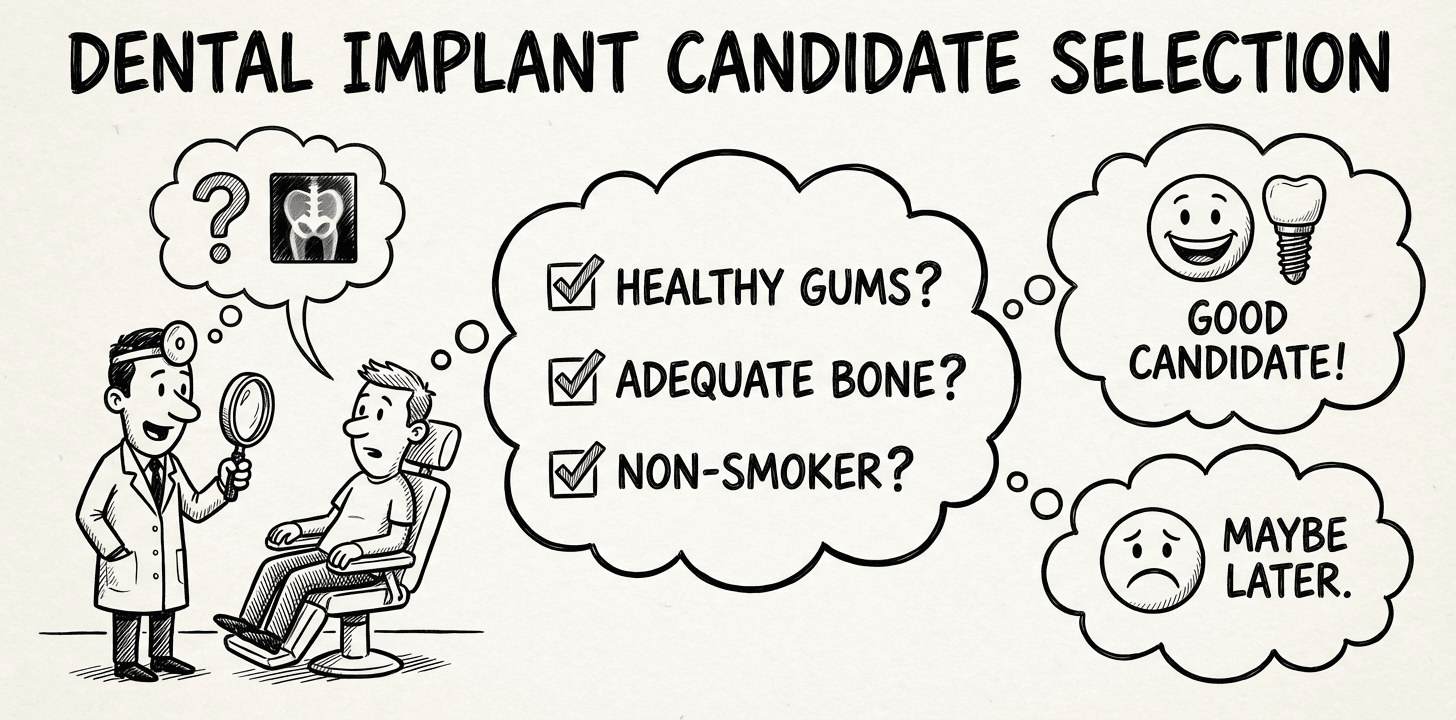
While dental implant therapy boasts success rates exceeding 95% in healthy populations, the reality of daily practice involves navigating complex medical histories, compromised anatomy, and behavioral risk factors that can compromise osseointegration1. Proper patient selection remains the single most critical determinant of long-term implant survival—more impactful than implant brand, surface technology, or surgical technique.
This guide synthesizes current evidence-based criteria to help clinicians identify ideal candidates, recognize absolute contraindications, and develop risk stratification protocols for complex cases.
The Foundation: Systemic Health Assessment
Absolute Contraindications (Proceed with Extreme Caution)
Uncontrolled Systemic Disease
Patients with poorly controlled diabetes (HbA1c >8-9%), active chemotherapy recipients, and those with recent myocardial infarction (within 6 months) face significantly elevated risks of implant failure and postoperative complications. The 2024 comprehensive review by Mosaddad et al. emphasizes that uncontrolled diabetes impairs collagen synthesis and bone matrix formation, disrupting the cellular cascade essential for osseointegration2.
Medication-Related Risks
Intravenous bisphosphonate therapy remains a relative contraindication due to the risk of osteonecrosis of the jaw3. However, oral bisphosphonates require individualized risk assessment based on treatment duration and bone density scores. Anticoagulant therapy requires careful coordination with the patient's physician but does not preclude implant placement when properly managed.
Relative Contraindications: The "Controlled vs. Uncontrolled" Distinction
The literature increasingly supports that many systemic conditions, when properly managed, do not significantly impact implant survival rates:
-
Cardiovascular Disease: Recent retrospective analyses of 246 consecutively treated patients found no statistically significant difference in implant failure rates between cardiovascular patients and healthy controls, provided the disease is stable and medical clearance is obtained.
-
Osteoporosis: Despite concerns about bone density, peripheral dual-energy x-ray absorptiometry (DEXA) scores poorly correlate with jawbone implant failure. Visual assessment of bone quality during drilling often proves more predictive than systemic bone density measurements.
-
Bleeding Disorders: Even hemophiliacs can achieve successful outcomes with preoperative factor replacement and coordination with hematology.
Site-Specific Risk Factors
Bone Quality and Quantity
The ITI SAC Classification (2nd Edition) emphasizes that ideal candidates require4:
- Adequate bone volume for primary stability (minimum 35 Ncm insertion torque)
- Favorable bone density (Type I-III per Lekholm and Zarb classification)
- Intact facial bone walls (>1mm thickness) for esthetic zone cases
For immediate implant placement protocols, CBCT assessment is mandatory to verify4:
- Absence of facial bone dehiscence
- Presence of ≥2mm gap between implant and facial bone wall (critical for esthetic zone survival)
- Sufficient apical bone for primary stability (≥3mm beyond the socket)
Periodontal Status
Active periodontal disease represents one of the strongest predictors of peri-implantitis. Ideal candidates demonstrate:
- Stable periodontal health with maintenance intervals established
- No residual pockets >4mm
- Controlled inflammation (BOP < 25%)
Patients with a history of aggressive periodontitis require heightened surveillance, as their inflammatory response patterns may predispose them to rapid peri-implant bone loss.
Behavioral and Psychosocial Considerations
Smoking and Alcohol Consumption
Tobacco Use: Current consensus identifies smoking as a significant risk factor for early implant failure. The inflammatory cascade induced by nicotine compromises blood flow and delays wound healing. While not an absolute contraindication, heavy smokers (>20 cigarettes/day) should be counseled on risk elevation and required to cease smoking for at least two weeks pre- and post-operatively.
Alcohol: Heavy alcohol consumption (>4 units/day) correlates with increased marginal bone loss and implant failure. Preoperative screening for alcohol use disorder should be standard for patients seeking complex rehabilitation.
Psychological and Cognitive Factors
Patient selection extends beyond biological criteria. Ideal candidates demonstrate:
- Realistic expectations regarding timelines, costs, and maintenance requirements
- Cognitive capacity to maintain oral hygiene protocols
- Financial stability for long-term maintenance (implants require professional care every 3-6 months)
- Compliance with preoperative instructions and postoperative care
Patients with untreated psychiatric conditions, severe dental anxiety, or unrealistic aesthetic expectations may require psychological clearance before proceeding.
Age Considerations: The Two Extremes
Adolescent Patients
Implant placement in growing patients risks submergence and malposition as the alveolar process continues vertical development. Girls typically complete skeletal growth by 14-15 years; boys by 17-18. Skeletal maturation assessment via hand-wrist films or serial cephalometric radiographs is mandatory before implant placement in patients under 20.
Geriatric Patients
Advanced age alone does not contraindicate implant therapy. Studies demonstrate comparable survival rates between octogenarians and younger cohorts5. However, the elderly often present with compounding factors—polypharmacy, xerostomia, reduced manual dexterity, and cognitive decline—that require modified maintenance protocols and simplified hygiene designs.
Risk Stratification Tools
ITI SAC Classification
Utilize the Straumann ITI SAC Classification to categorize case complexity:
- Straightforward: Single tooth, favorable anatomy, healthy patient
- Advanced: Multiple units, limited bone, controlled medical conditions
- Complex: Full-arch rehabilitation, severe bone atrophy, esthetic high-risk zones
Esthetic Risk Assessment (ERA)
For anterior maxillary cases, the ITI's Esthetic Risk Assessment evaluates:
- Smile line height
- Tissue biotype (thick vs. thin)
- Ridge deficiencies
- Restorative complexity
High esthetic risk cases require interdisciplinary planning and potentially staged bone and soft tissue augmentation before implant placement.
The Decision Algorithm
Ideal Candidate Profile:
- ASA Physical Status I or II
- HbA1c < 7% (if diabetic)
- Non-smoker or light smoker willing to quit
- Adequate bone volume or acceptance of grafting procedures
- Stable periodontal health
- Realistic expectations and compliance history
Red Flags Requiring Referral or Alternative Treatment:
- Active intravenous bisphosphonate therapy
- Uncontrolled diabetes or cardiovascular disease
- Severe bruxism without nightguard compliance
- Inadequate bone volume with refusal of augmentation
- Active substance abuse disorders
Conclusion
Successful implant dentistry begins with rigorous patient selection. While technological advances have expanded the boundaries of what is surgically possible, biological limitations remain immutable. The prudent practitioner evaluates not only the radiographic anatomy but the patient's systemic health, behavioral patterns, and psychosocial capacity for maintenance.
Remember: implant therapy is a commitment spanning decades, not months. Selecting patients who can maintain both the biological and mechanical aspects of their rehabilitation ensures that our 95% success rates translate from population statistics to individual patient outcomes.
References
Footnotes
-
Dharia M, Lee K. Navigating Patient Factors in Implant Dentistry: Strategies for Personalized Care and Improved Outcomes. J Oral Med and Dent Res. 2025;6(2):1-12. ↩
-
Mosaddad SA, et al. Dental implant considerations in patients with systemic diseases: An updated comprehensive review. J Oral Rehabil. 2024. doi:10.1111/joor.13683 ↩
-
Hwang D, Wang HL. Medical Contraindications to Implant Therapy: Part II. Implant Dent. 2007;16(1):13-23. ↩
-
Hamilton A, et al. Selection Criteria for Immediate Implant Placement and Immediate Loading for Single Tooth Replacement in the Maxillary Esthetic Zone. ITI Consensus Statements. 2023. ↩ ↩2
-
Taylor S, Miller C, Daley JO. Oral Health Considerations for Patients With Systemic Disease. StatPearls. 2025. ↩