Minimally Invasive Dentistry: Evidence-Based Techniques for Conservative Caries Management
Comprehensive guide to minimally invasive dentistry (MID) covering evidence-based techniques including Atraumatic Restorative Treatment (ART), Silver Diamine Fluoride (SDF), Hall Technique, chemomechanical caries removal, and resin infiltration.

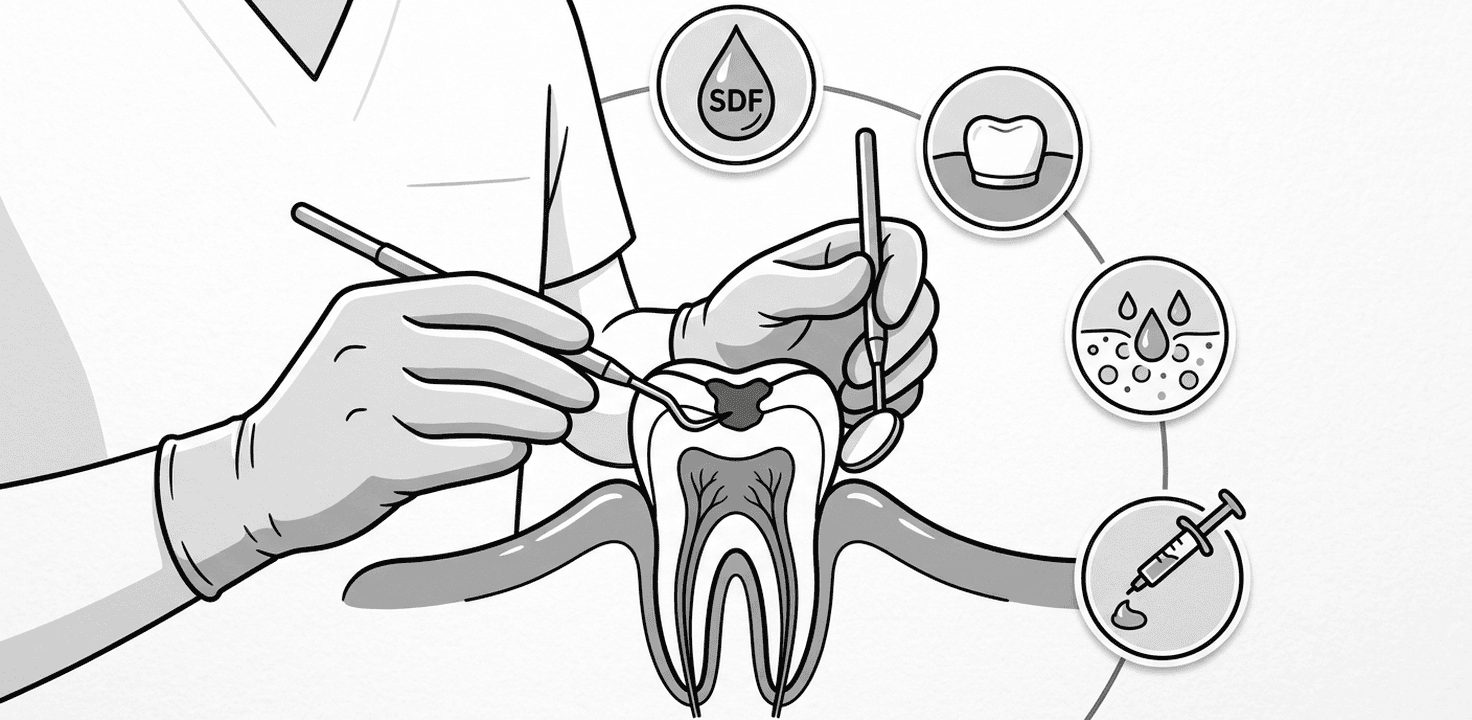
Minimally Invasive Dentistry: Evidence-Based Techniques for Conservative Caries Management
The paradigm in caries management has shifted dramatically from the traditional "extension for prevention" philosophy toward a more conservative, patient-centered approach. Minimally Invasive Dentistry (MID) represents this evolution—prioritizing the preservation of healthy tooth structure while effectively managing caries through evidence-based techniques.
This comprehensive guide examines the core principles of MID and evaluates the clinical evidence supporting its most impactful techniques.
Understanding the MID Philosophy
Minimally Invasive Dentistry operates on several fundamental principles:
- Early detection of lesions through risk assessment and advanced diagnostic tools
- Remineralization of demineralized enamel and dentin
- Minimal tissue removal when intervention is necessary
- Repair over replacement of defective restorations
- Patient-centered care that considers behavior, preferences, and circumstances
The goal is not merely to treat caries but to preserve teeth throughout life by intercepting disease progression at its earliest stages.
Evidence-Based MID Techniques
1. Atraumatic Restorative Treatment (ART)
Developed in the 1980s for resource-limited settings, ART has evolved into a widely accepted minimally invasive approach that uses hand instruments alone to remove carious tissue, followed by restoration with adhesive materials—typically high-viscosity glass ionomer cement (HVGIC).
Clinical Evidence
A 2024 prospective observational cohort study following 200 children over 24 months found that ART restorations demonstrated significantly higher survival rates than conventional composite restorations in primary molars. The Kaplan-Meier survival curves revealed the ART advantage became more pronounced over time, with consistent performance across subgroups regardless of oral hygiene status or cavity type.
Key findings include:
- ART survival rates of 75-90% over 2-3 years for single-surface cavities
- Reduced need for local anesthesia
- Lower patient anxiety and improved cooperation
- Cost-effectiveness in diverse clinical settings
A 2025 systematic review evaluating 18 studies concluded that ART is a reliable, minimally invasive technique particularly valuable in pediatric dentistry, though a Cochrane review noted that evidence quality remains low to moderate for comparisons with conventional approaches.
When to Consider ART
- Young or anxious pediatric patients
- Resource-limited environments
- Cases where rotary instrumentation may provoke cooperation challenges
- Single-surface and some multi-surface lesions in primary teeth
2. Silver Diamine Fluoride (SDF)
SDF represents a revolutionary non-restorative approach to caries management. This colorless topical solution combines silver ions (antimicrobial) with fluoride (remineralizing) to arrest caries progression without tissue removal.
Clinical Evidence
A 2025 umbrella review analyzing systematic reviews with high confidence ratings found that 38% SDF consistently achieves caries arrest rates of 53-91%, depending on application frequency. A prospective adult study demonstrated 85% caries arrest at 6 months compared to 45% with standard fluoride varnish.
The FDI World Dental Federation has formally endorsed SDF as an effective minimally invasive treatment, noting:
- Arrests cavitated lesions not encroaching on pulp
- Particularly effective for young children and special needs patients
- No aerosol generation (reduced cross-infection risk)
- Suitable for clinic, community, and remote settings
Important Considerations
The primary limitation is irreversible black staining of carious lesions due to silver ion reaction with demineralized tissue. Patient/parent informed consent regarding this aesthetic outcome is essential. Research into staining mitigation, including potassium iodide application and modified formulations, continues.
Clinical Applications
- Arresting cavitated lesions in uncooperative children
- Caries management in patients with special healthcare needs
- Interim treatment for patients with limited access to care
- High-caries-risk patients awaiting definitive restoration
3. The Hall Technique
The Hall Technique involves sealing carious primary molars with preformed metal crowns without local anesthesia, tooth preparation, or caries removal. The crown seals the lesion from biofilm access, arresting progression through isolation.
Clinical Evidence
A 2025 network meta-analysis of over 12,000 treated primary teeth found the Hall Technique demonstrated the highest success rates among minimally invasive treatments:
- At 6 months: Significantly outperformed placebo (OR 163.59), ART (OR 4.87), and conventional treatment (OR 3.66)
- At 12-24 months: Maintained superiority over ART (OR 5.13) and conventional approaches (OR 4.17)
- Survival rates of 92% over approximately 5 years in landmark studies
The 2018 systematic review and network meta-analysis by Tedesco et al. identified the Hall Technique as having the best success rate for occlusoproximal cavities among all evaluated treatments.
Advantages
- No injections or drilling required
- Excellent patient acceptance
- High restoration survival
- Effective for multi-surface lesions
Considerations
- Occlusal adjustment may be needed initially
- Aesthetic concerns for some parents
- Not suitable for teeth with signs of irreversible pulpitis
4. Chemomechanical Caries Removal
Chemomechanical systems use enzymatic or chemical gels to soften infected dentin, enabling removal with hand instruments rather than burs. Products include Carisolv (sodium hypochlorite-based), Papacarie (papain-based), and Carie-Care.
Clinical Evidence
A 2025 systematic review comparing Papacarie and Carisolv found:
- Papacarie demonstrated faster caries removal (385.8 vs 427.13 seconds)
- Reduced bacterial remnants post-excavation with Papacarie
- Significantly lower pain perception compared to conventional methods
- Both agents conservative—no dentinal tubule destruction observed
The proteolytic enzyme papain in Papacarie specifically targets infected tissue while sparing sound dentin, as infected tissue lacks the antiprotease (α1-antitrypsin) that inhibits protein digestion in healthy tissue.
Clinical Indications
- Anxious pediatric patients
- Deep lesions near pulp (conservative excavation)
- Preservation of affected dentin for remineralization
- Cases requiring selective caries removal
5. Resin Infiltration
Resin infiltration represents a micro-invasive approach for non-cavitated proximal lesions. A low-viscosity resin (typically TEGDMA) penetrates and seals the porous lesion structure, blocking acid diffusion and mechanically stabilizing demineralized enamel.
Clinical Evidence
A 2023 systematic review and meta-analysis concluded there is firm evidence for resin infiltration arresting proximal caries in both primary and permanent teeth. A 2025 clinical trial comparing resin infiltration, remineralization, and control over 2 years found:
- Infiltration group: 3% lesion progression at 1 year, 0% additional at 2 years
- Remineralization group: 18% progression at 1 year, 3.6% additional at 2 years
- Control group: 28.3% progression at 1 year, 5% additional at 2 years
Earlier studies have shown 93% success rates at 18 months and 96% at 3 years for infiltrated lesions versus 37% and 58% progression rates in controls, respectively.
Procedure Overview
- Temporary tooth separation with wedges
- Surface etching with 15% HCl (2 minutes)
- Rinsing, drying, ethanol application
- Resin infiltration (3 minutes)
- Polymerization and reapplication
Best Applications
- E2 lesions (inner half of enamel) — highest efficacy
- Early D1 lesions (outer third of dentin)
- Patients with medium-to-high caries risk
- Lesions where conventional access would sacrifice significant healthy structure
Comparative Clinical Decision Framework
| Technique | Best Indications | Key Evidence | Primary Limitations |
|---|---|---|---|
| ART | Primary teeth, resource-limited settings, anxious children | 75-90% 2-3 year survival | Time-intensive; technique sensitive |
| SDF | Cavitated lesions, uncooperative patients, high caries risk | 85% arrest at 6 months | Permanent black staining |
| Hall Technique | Multi-surface primary molar lesions | 92% 5-year survival | Crown placement technique |
| Chemomechanical | Deep lesions, anxiety management | Less pain, preserves dentin | Longer procedure time |
| Resin Infiltration | Non-cavitated proximal lesions | 93-96% 2-3 year success | Technique sensitive; limited to early lesions |
Practical Implementation in Practice
Patient Assessment
Before selecting an MID technique, conduct comprehensive:
- Caries risk assessment — behavioral, biological, and protective factors
- Lesion classification — surface, depth, activity status
- Patient factors — age, cooperation, medical history, access to care
- Parent/patient preferences — aesthetic concerns, treatment philosophy
Integration into Workflow
- Train team members on MID principles and patient communication
- Stock appropriate materials — HVGIC, SDF, resin infiltration kits
- Develop protocols for lesion documentation and recall intervals
- Obtain informed consent explaining limitations (e.g., SDF staining)
Monitoring and Follow-up
MID techniques require ongoing surveillance:
- Short recall intervals (3-6 months) initially
- Radiographic monitoring for infiltrated lesions
- Clinical assessment of arrested lesions for surface integrity
- Parent education on ongoing risk management
The Future of Minimally Invasive Dentistry
Emerging developments in MID include:
- Bioactive materials that promote remineralization beyond fluoride
- Peptide-based therapies for enamel regeneration
- Advanced diagnostic technologies (OCT, near-IR) for earlier lesion detection
- Smart restorative materials with antibacterial and remineralizing properties
- Modified SDF formulations with reduced staining
Research continues to refine the evidence base, with ongoing trials comparing combination therapies and evaluating long-term outcomes.
Conclusion
Minimally Invasive Dentistry represents a fundamental shift from reactive to proactive, patient-centered caries management. The evidence strongly supports the efficacy of techniques including ART, SDF, Hall Technique, chemomechanical removal, and resin infiltration across diverse clinical scenarios.
Success requires appropriate case selection, technique proficiency, and patient engagement. By preserving tooth structure, reducing patient discomfort, and improving access to care, MID techniques align with contemporary dentistry's goal of maintaining oral health throughout life.
References
-
Mondal A, et al. Comparative Long-Term Clinical Performance of Atraumatic Restorative Treatment Versus Conventional Composite Restorations in Carious Primary Molars: A Prospective Observational Cohort Study. Cureus. 2025;17(3). doi:10.7759/cureus.76430
-
Frencken JE, et al. Atraumatic restorative treatment for dental caries. Cochrane Database Syst Rev. 2017. doi:10.1002/14651858.CD008072.pub2
-
Effect of minimal intervention on carious lesions in primary teeth. An umbrella review. Front Dent Med. 2025;6:1751752. doi:10.3389/fdmed.2025.1751752
-
Caries Management With Silver Diamine Fluoride. FDI Policy Statement. Int Dent J. 2025;76(1):104000. doi:10.1016/j.identj.2025.104000
-
Comparative success of minimally invasive treatments for cavitated caries in primary teeth: a network meta-analysis. BMC Oral Health. 2025;25:1469. doi:10.1186/s12903-025-06832-3
-
Tedesco TK, et al. Scientific evidence for the management of dentin caries lesions in pediatric dentistry: A systematic review and network meta-analysis. PLoS ONE. 2018;13(11):e0206296. doi:10.1371/journal.pone.0206296
-
Comparative evaluation of Papacarie and Carisolv in effective chemomechanical carious dentin removal in primary teeth: A systematic review. Dent Res J (Isfahan). 2025;22:33. doi:10.4103/drj.drj_205_23
-
Todorova V, Filipov I. One- and Two-Year Efficacy of Resin Infiltration and Remineralization for the Treatment of Initial Proximal Caries. J Clin Med. 2025;14(13):4456. doi:10.3390/jcm14134456
-
Resin Infiltration of Non-Cavitated Proximal Caries Lesions in Primary and Permanent Teeth: A Systematic Review and Meta-Analysis. J Clin Med. 2023;12(2):727. doi:10.3390/jcm12020727
-
Arslan S, Kaplan MH. The Effect of Resin Infiltration on the Progression of Proximal Caries Lesions: A Randomized Clinical Trial. Eur J Dent. 2020;14(4):596-601. doi:10.1055/s-0040-1714077
Last updated: March 20, 2026