Reducing No-Show Rates: Data-Driven Scheduling Strategies for Dental Practices
Learn evidence-based strategies for reducing no-show rates—from predictive analytics and targeted interventions to optimized scheduling protocols.

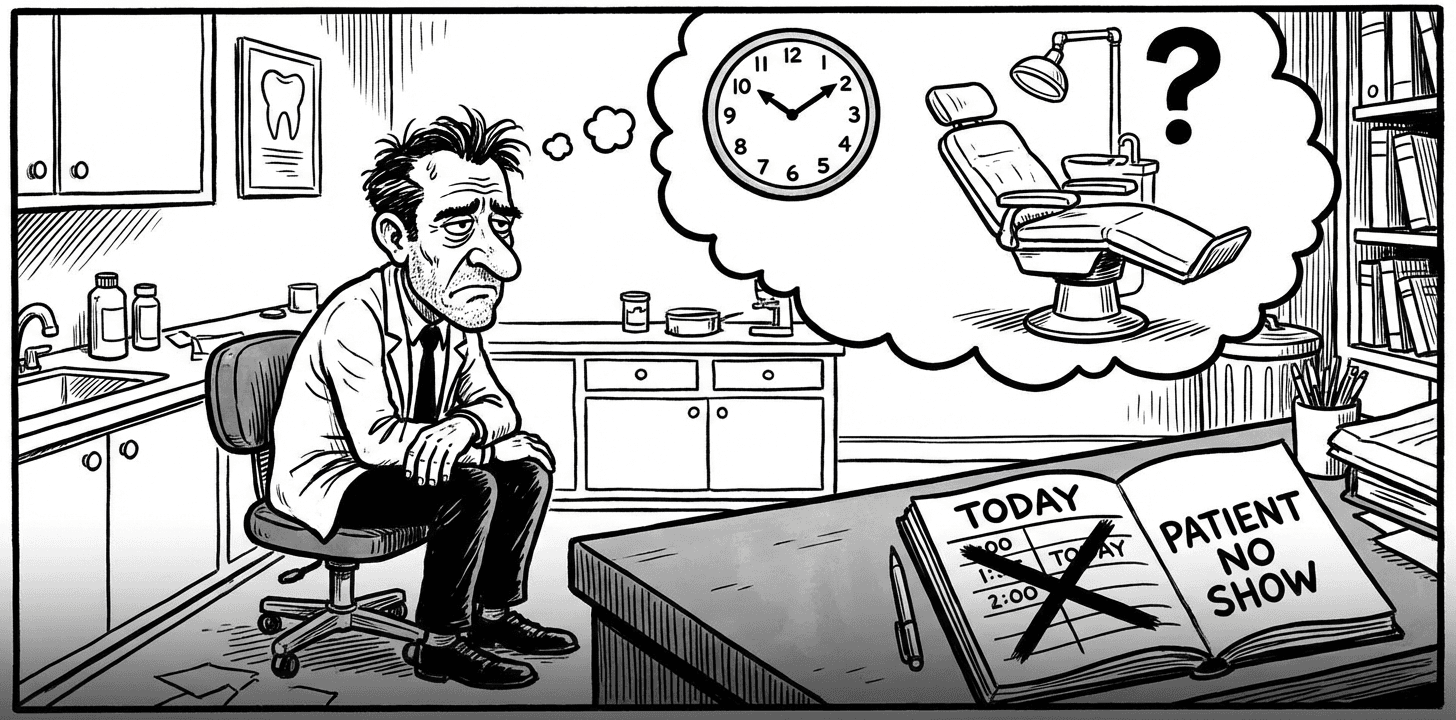
Patient no-shows represent one of the most significant operational challenges in dental practice management, with missed appointments reaching up to 58% in some regions and costing the U.S. healthcare system an estimated $150 billion annually12. Unlike general medical appointments averaging 17.4 minutes, dental procedures typically require 48.7 minutes—nearly three times as long—making each vacancy particularly costly2. This article examines evidence-based, data-driven strategies to mitigate no-shows through predictive analytics, targeted interventions, and optimized scheduling protocols.
The Scope of the No-Show Problem in Dentistry
No-show behavior varies significantly across medical specialties, with dental clinics experiencing unique challenges. Research indicates that while oncology and urology clinics report no-show rates of 6–7%, dental specialties frequently encounter rates exceeding 20%23. The consequences extend beyond lost revenue: patient health outcomes deteriorate when preventive care is delayed, and irregular attendance correlates with increased emergency visits and treatment complications4.
Traditional "blind" overbooking—scheduling extra patients based on historical averages without individual risk assessment—often fails in dental settings. Aggressive overbooking crowds clinics and extends wait times, while conservative approaches fail to offset the high opportunity cost of lengthy dental procedures2.
Predictive Analytics: Identifying High-Risk Patients
Machine Learning Applications
Recent advances in machine learning enable precise no-show prediction at the individual patient level. A study analyzing dental appointments using binary sequence encoding of patient history (representing attended appointments as 1 and missed as 0) achieved an Area Under the Curve (AUC) of 0.718 and F1 scores of 66.5%2. These models analyze patterns across the last 3–10 appointments to identify behavioral trends rather than relying on simple attendance percentages.
Key predictive variables consistently identified across studies include:
- Prior no-show history: The strongest predictor of future behavior25
- Appointment lead time: Longer intervals between scheduling and appointment increase no-show likelihood6
- Socioeconomic indicators: Transportation barriers, insurance status, and neighborhood deprivation7
- Appointment characteristics: Time of day, day of week, and procedure complexity6
Decision Support Systems
Topuz et al. (2024) developed an intelligent scheduling framework utilizing individual no-show probabilities to optimize appointment placement and overbooking decisions6. Their probability-based greedy approach schedules high-risk patients in slots with lowest baseline no-show likelihoods, while marginal analysis determines optimal overbooking levels based on predicted attendance rates. This methodology demonstrated significant improvements in profit margins, cost reduction, and patient throughput compared to traditional scheduling6.
Evidence-Based Intervention Strategies
Targeted Reminder Systems
Systematic reviews provide robust evidence for reminder interventions. Oikonomidi et al. (2023) found high-certainty evidence that predictive model-based text message reminders reduce no-shows (median risk ratio 0.91), while phone call reminders showed moderate-certainty evidence with greater effect sizes (median RR 0.61)4. The Cochrane review of mobile messaging reminders confirmed these findings, showing attendance rates of 78.6% with SMS reminders versus 67.8% without reminders8.
Optimal reminder protocols:
- Timing: Multiple touchpoints outperform single reminders; adding daily reminders to weekly messages increases confirmation rates by 26%9
- Method: While patient preference should guide selection, SMS demonstrates slightly superior performance (1.90% no-show rate) compared to email (2.68%) and phone calls (3.49%)10
- Content: Messages incorporating behavioral economic insights—such as social norms or loss-framed messaging regarding appointment costs—may enhance effectiveness3
Dynamic Overbooking
Rather than static overbooking, data-driven approaches utilize individual patient risk scores to determine when overbooking is appropriate. Samorani and LaGanga's research on day-dependent no-show predictions demonstrates that scheduling patients with high predicted attendance alongside those with high no-show probability optimizes capacity utilization while minimizing patient wait times6.
For dental practices specifically, Alabdulkarim et al. (2022) recommend duration reduction strategies for high-risk appointments rather than traditional overbooking, given the extended length of dental procedures2. Shortening high-risk appointments or scheduling them during lower-demand periods mitigates vacancy costs without the operational disruption of double-booking lengthy procedures.
Open Access and Advanced Access Scheduling
While less studied in dental settings, open access scheduling—where patients book appointments within 24–48 hours rather than weeks in advance—reduces no-shows by minimizing the lead time during which patients may experience changed circumstances. However, this requires sophisticated demand-capacity balancing and may be most suitable for hygiene recalls rather than complex restorative procedures.
Telehealth Integration
Recent meta-analyses indicate that telehealth models significantly reduce non-attendance compared to in-person visits. Greenup and Best (2025) analyzed 45 studies post-COVID-19, finding that virtual care demonstrated a 39% reduction in no-show risk compared to traditional appointments (OR 0.61, p < 0.0001)11. While clinical limitations exist for operative dentistry, virtual consultations for treatment planning, post-operative checks, and orthodontic monitoring present viable pathways to reduce physical appointment burdens and associated no-shows.
Implementation Framework for Dental Practices
Phase 1: Data Infrastructure (Months 1–2)
- Implement electronic health record (EHR) tracking of no-show history as binary sequences rather than simple percentages
- Establish baseline metrics: overall no-show rate, no-show by appointment type, provider, and time slot
- Calculate direct costs (lost production) and indirect costs (staff idle time, rescheduling efforts)
Phase 2: Predictive Model Deployment (Months 3–4)
- Utilize existing practice management software analytics or implement machine learning models using historical appointment data
- Segment patients into risk categories: Low (< 10% no-show probability), Moderate (10–30%), and High (>30%)
- Integrate risk scores into daily scheduling dashboards
Phase 3: Intervention Protocols (Month 5 onward)
For High-Risk Patients:
- Dual reminder system (SMS + phone call)
- Appointment confirmation required 48 hours prior
- Consider same-day scheduling when possible
- Implement patient navigator calls for complex treatment plans4
For Moderate-Risk Patients:
- Standard SMS reminders at 1 week and 1 day pre-appointment
- Open scheduling blocks to reduce lead times
For Low-Risk Patients:
- Standard automated reminders
- Eligible for extended advance scheduling privileges
Phase 4: Continuous Quality Improvement
- Monitor intervention effectiveness through control charts tracking no-show rates by risk category
- A/B test reminder messaging content and timing
- Quarterly review of predictive model accuracy and recalibration
Cost-Benefit Considerations
Economic analyses demonstrate favorable returns on investment for automated reminder systems. Automated SMS reminders cost approximately €0.14 per patient compared to €0.90 for manual telephone reminders, while achieving comparable attendance improvements9. When combined with predictive overbooking, practices can expect 15–35% reductions in no-show rates, translating to substantial revenue recovery given the high value of dental appointment time29.
Conclusion
Reducing dental no-shows requires moving beyond reactive strategies to predictive, data-driven approaches. By leveraging machine learning to identify high-risk patients, implementing targeted reminder protocols based on risk stratification, and optimizing scheduling through intelligent overbooking or telehealth alternatives, practices can significantly improve operational efficiency and patient care continuity. The integration of behavioral economic principles and patient preference considerations ensures that these strategies enhance rather than disrupt the patient experience.
As dental practices increasingly adopt digital health technologies, the capability to predict and prevent no-shows will become a competitive necessity. Practices implementing these evidence-based strategies report not only improved attendance rates but enhanced patient satisfaction through reduced wait times and more efficient care delivery.
References
Footnotes
-
Marbouh D, Khaleel I, Al Shrouf F, et al. Evaluating the impact of patient no-shows on service quality. Risk Manag Healthc Policy. 2020;13:509-517. doi:10.2147/RMHP.S241428 ↩
-
Alabdulkarim Y, Almukaynizi M, Alameer A, et al. Predicting no-shows for dental appointments. PeerJ Comput Sci. 2022;8:e1147. doi:10.7717/peerj-cs.1147. Available at: https://pmc.ncbi.nlm.nih.gov/articles/PMC9680883/ ↩ ↩2 ↩3 ↩4 ↩5 ↩6 ↩7 ↩8
-
Werner K, Alsuhaibani SA, Alsukait RF, et al. Behavioural economic interventions to reduce health care appointment non-attendance: a systematic review and meta-analysis. BMC Health Serv Res. 2023;23:1136. doi:10.1186/s12913-023-10059-9 ↩ ↩2
-
Oikonomidi T, Norman G, McGarrigle L, Stokes J, van der Veer SN, Dowding D. Predictive model-based interventions to reduce outpatient no-shows: a rapid systematic review. J Am Med Inform Assoc. 2023;30(3):559-569. doi:10.1093/jamia/ocac242 ↩ ↩2 ↩3
-
Goffman RM, Harris SL, May JH, et al. Modeling patient no-show history to predict future outpatient appointment behavior in the Veterans Health Administration. Mil Oper Res. 2017;22(2):25-41. ↩
-
Topuz K, Urban TL, Russell RA, Yildirim MB. Decision support system for appointment scheduling and overbooking under patient no-show behavior. Ann Oper Res. 2024;342(1):845-873. doi:10.1007/s10479-023-05799-0 ↩ ↩2 ↩3 ↩4 ↩5
-
Chou EY, Moore K, Zhao Y, et al. Neighborhood effects on missed appointments in a large urban academic multispecialty practice. J Gen Intern Med. 2022;37(4):785-792. ↩
-
Gurol-Urganci I, de Jongh T, Vodopivec-Jamsek V, Atun R, Car J. Mobile phone messaging reminders for attendance at healthcare appointments. Cochrane Database Syst Rev. 2013;(12):CD007458. doi:10.1002/14651858.CD007458.pub3 ↩
-
Parikh A, Gupta K, Wilson AC, et al. The effectiveness of outpatient appointment reminder systems in reducing no-show rates. Am J Med. 2010;123(6):542-548. ↩ ↩2 ↩3
-
Wegrzyniak LM, Hedderly D, Chaudry K, Bollu P. Measuring the effectiveness of patient-chosen reminder methods in a private orthodontic practice. Angle Orthod. 2018;88(3):314-318. doi:10.2319/090517-597.1. Available at: https://pmc.ncbi.nlm.nih.gov/articles/PMC8288327/ ↩
-
Greenup EP, Best D. Systematic review and meta-analysis of no show or non-attendance rates among telehealth and in-person models of care. BMC Health Serv Res. 2025;25:663. doi:10.1186/s12913-025-12826-2 ↩